[Commissioned by @justicegundam82. The 3e Fiend Folio is a weird book. The mechanics, which are a hybrid of 3.0 and 3.5. The pierced nipples on the cover (seriously). But weirdest of all was “the competition”. Many of the designers for the book were tasked with creating an extraplanar humanoid race with the goal of making a new equivalent of the githyanki, the breakout stars of the original AD&D Fiend Folio. The nerra were one of those attempts.
The commissioner wanted the nerra to have the flavor from their reappearance in 4e’s Monster Manual 3, but challenge ratings equivalent to their Fiend Folio versions. I’ve borrowed some abilities from their 4e versions. The original were from a demiplane, the Plane of Mirrors, but I’ve moved them to the Shadow Plane to avoid plane inflation, and changed their alignments from N to CN to fit the 4e lore.]
Nerra The
Shadow Plane is often said to be a dark reflection of the Material, and no
creature embodies this as thoroughly as the nerra. The nerra are a race of
outsiders that appear as humanoids made of mirrors. They have a mystical
connection to mirrored surfaces, allowing them to transport themselves via
mirrors when conducting research or missions on the Material Plane. All nerra
can disguise themselves as humanoids, and they particularly enjoy taking the
appearance of a prominent person in order to act radically out of character and
witness the chaos that results. They are observant creatures with a particular
interest in the forces of good and evil—they appear to destabilize societies
ruled strongly by one or the other of these forces and determine whether the
original balance is restored.
The
origins of the nerra are mysterious. Some argue that they are the natives of a
lost demiplane, the Plane of Mirrors. Others suggest that they are transformed
mortals, turned into strange creatures through a ritual. Whether the
transformation to nerra was their goal or an accident depends on the version of
the legend. The nerra do not comment on their origins with other species. They
are distrustful of the gods and the outsiders that serve them, but have a
particular hatred for kytons and the aberrations of the Dominion of the Black. Although
they are found throughout the planes, their bastion is the Panopticon, a
fortress of mirrors the size of a city.
Nerra Traits All nerra
are outsiders with the following traits:
Reflection of Man (Su) All nerra have access to disguise self as a spell-like ability.
When a nerra uses disguise self, it can only appear as a humanoid. A nerra does
not suffer a penalty to Disguise checks for impersonating a Medium humanoid. Mirrorwalk (Su) A nerra can enter a mirror as a
standard action and transport itself to another mirrored surface. This
functions as the spell tree stride, except
the nerra can determine the type and distance of other mirrors or mirrored
surfaces. The types of mirrored surfaces, and the distance able to be traveled
through them, are as follows:
o Silvered mirror: 3,000 feet.
o Polished glass: 2,000 feet.
o Polished metal: 1,500 feet.
o Water or other reflective surface: 1,000 feet.
A nerra may use this ability a number of times/day equal
to its Hit Dice. A nerra may not use mirrorwalk through its own body or the
body of another nerra. Reflective Spell Resistance (Su) Whenever a targeted spell or
spell-like ability fails to overcome a nerra’s spell resistance, the spell
rebounds on its caster, as per the spell
turning spell. This ability also affects rays and ranged touch attack
spells, even though these are normally not affected by spell turning. Resist 10 cold, fire and
electricity Vulnerable to sonic
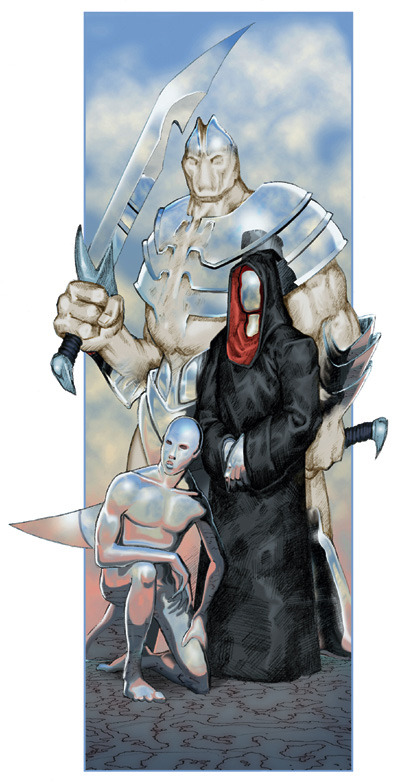
Nerra, Varoot This thin humanoid is covered from
head to toe in a mirror-like sheen. It wears no clothes and carries a wicked
looking dagger.
The
varoot are the weakest of the nerra, but they make up for their physical
frailty with guile. They are scouts and spies for the nerra, assuming the form
of a mortal in order to gather as much information about their life and allies
as possible. They are gifted in disguise even without magic, and may use
multiple layers of magical and mundane disguise to confound their enemies. A
varoot rarely wears clothing or armor, unless it is when they are “in
character”.
A varoot
rarely engages in direct combat if they can help it, but carry daggers to
defend themselves with if necessary. Their favorite tactic is to assume the appearance
of one of their enemies and engage them directly in melee—the magic of the
varoot is such that opponents attacking it will be confounded and attack the
model for its appearance. Any weapon carried by a varoot inflicts deadly
bleeding wounds, and a varoot will not hesitate to use the distraction of this
bleeding to take the opportunity to flee.
A varoot
typically advances by class level. They prefer classes that augment their
deceptive abilities, such as bard or rogue. A varoot is the size of a small
human, rarely exceeding five and a half feet in height.

 Shores of Swords